Domain authority checker: a free 0‑100 score from the link graph, compared with competitors
A free domain authority checker: a 0‑100 score from the public Common Crawl link graph, your position in the graph and a comparison with up to three competitors in one step. No sign-up and no email.
Short answer
Domain authority is a rating of how firmly a website is embedded in the web of links, on a scale from 0 to 100. Our domain authority checker calculates it from the public Common Crawl link graph (134,979,706 domains, crawls from August-October 2026): the closer other websites are to a domain in this network and the stronger the domains linking to it, the higher the score. It is our own metric, not Ahrefs Domain Rating or Moz Domain Authority. You see the score and the competitor comparison right away and for free.
What you get for free
Right away, no email needed
- Your domain authority score on a 0-100 scale from the Common Crawl link graph
- Your rank and percentile among 1,248,204 .pl domains and your position in the whole graph
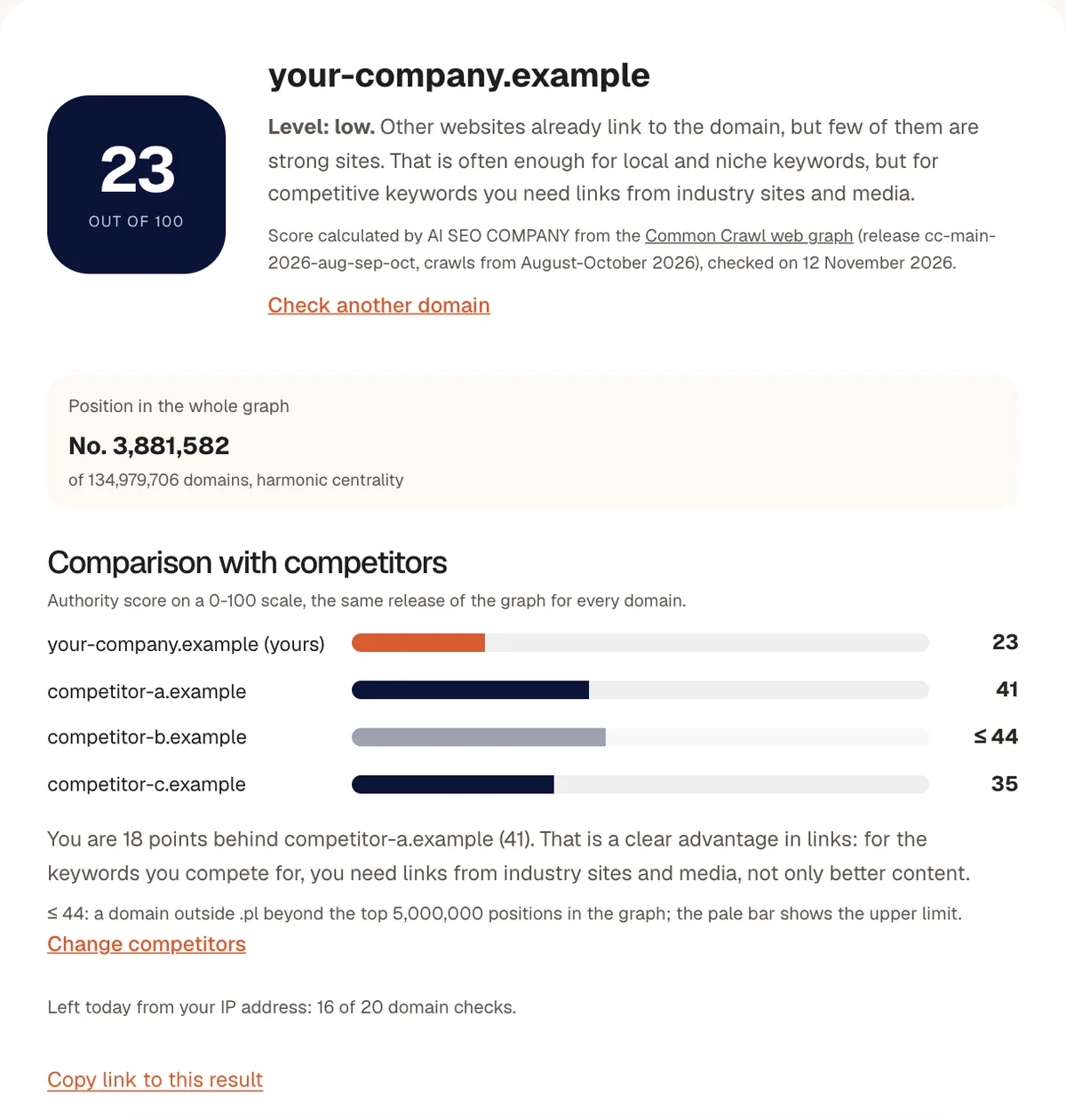
- A comparison with up to three competitors on one chart
- For .pl domains: the number of linking domains and the five strongest, for competitors too
- Your authority level and your gap to the strongest competitor
- A counter of today’s checks and a link to the result you can copy
After you enter your email
- A report with the score, the comparison and the data release
- An action plan in order: where to start earning links at your score
- Which links to avoid so that you do not risk a Google penalty
The email does not unlock anything on the page: you see the whole result without it. Every score comes with its data source and the graph release.
What is domain authority
Domain authority is a conventional measure of a website’s strength in the web of links. A link from another website works like a recommendation: the more strong websites point to your domain, the easier it is for a search engine to treat it as a trustworthy source. Google does not publish its own authority number, so the SEO industry relies on measures from tools, and each tool calculates it from its own link database.
We calculate our score ourselves from the public Common Crawl link graph. It is a number from 0 to 100: the higher it is, the closer the domain is to the centre of the network and the stronger the domains linking to it. A score of 0 means that the data contains no links to the domain or that the domain is not in the graph at all.
Next to the score we also show the domain’s rank among the 1,248,204 .pl domains in the graph and its percentile, that is the share of .pl domains with a worse position in the graph. For domains with other endings we give the position in the whole graph, which has 134,979,706 domains.
How we calculate the score from Common Crawl data
Common Crawl is a US non-profit foundation that regularly crawls public web pages and makes the data available for free. From the links found on those pages it builds a graph: a node is a domain and an edge is a link from one domain to another. The current release, cc-main-2026-aug-sep-oct, was built from three crawls from August-October 2026 and has 134,979,706 domains and 1.8 billion edges between them. The file with domain positions was published on 22 October 2026. Source: Common Crawl release note.
For every domain Common Crawl gives two ranking positions, and we turn them into a score in four steps:
- Harmonic centrality. For every domain, the inverse distances from all other domains, counted in hops along links, are added up. A domain that most of the network reaches by short paths ranks high. A link farm does not shorten those paths, so it is hard to inflate this position with one. According to Boldi and Vigna’s study “Axioms for Centrality”, it is the only measure compared there that satisfies all three proposed axioms.
- PageRank. A link from a domain that itself receives many links weighs more. This measure reflects the number and strength of links better, but it is easier to inflate with spam links.
- The weaker of the two signals. We take the worse of the two positions. Spam raises PageRank but not centrality. A single link from a very central website raises centrality but not PageRank. Only a domain with both signals strong gets a high score.
- A 0-100 scale. We turn the position r into a score = 100 × (1 − (log r / log r0)³), where r0 is the number of domains with at least one incoming link (122,245,823 in this release). Position 1,000 is 95 points, 100,000 is 76 and one million is 59.
The scale is logarithmic and gets harder towards the top: at the bottom, 10 points mean roughly a twice better position in the graph, between 40 and 60 points 2.5-3 times for every 10 points, and between 80 and 90 almost 10 times. The formula has the version cc-hcpr-v1. If we change it, the new version will get a new number.
Common Crawl does not calculate this score and is not responsible for it; we use the data it publishes for everyone. We look the domain up in our own copy of the calculated data, so the address you enter is not passed to an outside company.
How it differs from Ahrefs Domain Rating and Moz Domain Authority
| Feature | Our score | Domain Rating (Ahrefs) | Domain Authority (Moz) |
|---|---|---|---|
| Calculated by | AI SEO COMPANY | Ahrefs | Moz |
| Link data | the public Common Crawl graph, 134,979,706 domains | Ahrefs’ own link database | Moz’s own link database |
| What it measures | the domain’s position in the graph: harmonic centrality and PageRank, the weaker of the two | unique linking domains and their own DR | a machine learning model, mainly based on link data, that predicts the ability to rank |
| Scale | 0-100, logarithmic | 0-100, logarithmic | 1-100 |
| Freshness | graph releases, each covering 3 months of crawling (now: August-October 2026) | continuous, according to Ahrefs | with Moz index updates |
Sources: Ahrefs Help, “What is Domain Rating (DR)” (accessed 11 November 2026), Moz, “What is Domain Authority” and Common Crawl, Web Graphs (accessed 12 November 2026).
We checked how our score agrees with Moz data on its list of the 500 most popular domains (Moz Top 500, 441 matched domains, 12 November 2026). The Spearman rank correlation with the number of linking domains according to Moz is about 0.57, and with DA alone about 0.37. That is moderate agreement: the measures order domains similarly, but not in the same way. PageRank alone agreed with Moz better (0.72), but it gave inflated scores to small Polish domains with spam links, so we do not use it on its own. We have not yet measured the agreement in the middle of the scale, where most businesses are.
Four domains from our tests, including our own ai-seo-company.pl, show the difference: all of them score 9 with us, while their DR according to Ahrefs measurements from 11 November 2026 ranged from 0 to 54, depending on the domain and the DR version. Two of them owed their high DR to spam links. So do not convert our score into DR or DA. Compare domains using one metric and stick to it in later checks.
How to read the result against competitors
The number alone says little. A score of 25 can be strong for a clinic in a mid-sized city and weak for a shop competing for nationwide keywords. That is why the tool compares you with up to three competitors right away, with no email.
Who to enter as a competitor
The companies in Google’s top 10 for your most important keywords, not the biggest brands in your industry. Search for the phrase customers use to find you and take the domains from the first results, skipping portals and directories. If you compete locally, compare yourself with companies in the same city.
Score levels
- 0-9, very low: typical of new and small websites. About 60% of .pl domains in the graph score 10 points or less.
- 10-24, low: the domain already has links, but few from strong sites. Often enough for local and niche keywords.
- 25-44, medium: a solid position in the web of links. About 5% of .pl domains score more than 30 points.
- 45-69, high: a strong position, the level of well-known companies and large shops. Less than 1% of .pl domains score more than 50 points.
- 70-100, very high: the largest websites. About 340 .pl domains score more than 70 points.
The level thresholds are ours, set on the distribution of .pl domain scores in the cc-main-2026-aug-sep-oct release. Treat them as a guide: the comparison with competitors is what decides.
Example scores for reference
| Domain | Score | Rank among .pl domains |
|---|---|---|
| google.com | 100 | not applicable |
| wikipedia.org | 99 | not applicable |
| onet.pl | 92 | 3 |
| allegro.pl | 91 | 5 |
| wp.pl | 87 | 10 |
| olx.pl | 84 | 35 |
| mbank.pl | 82 | 62 |
| x-kom.pl | 68 | 509 |
| decathlon.pl | 64 | 1,735 |
| rossmann.pl | 52 | 7,939 |
Source: our calculations from the Common Crawl link graph, 12 November 2026.
Large shops come out lower with us than portals: x-kom.pl and mediaexpert.pl score 67-68 and rossmann.pl 52, although they are well-known brands with many links. Their weaker signal is centrality, and the score takes the weaker signal. If you compare yourself with a shop, keep in mind that its lead in links may be bigger than the score shows.
How we describe your gap to the strongest competitor
- You have the highest score: on links these companies are not ahead of you. You build an edge with content and with links to the pages that sell.
- A gap of up to 5 points: content and how well a page matches the question decide rankings more often than the link profile.
- 5 to 20 points: a clear advantage in links for the competitor. You need links from industry sites and media, not only better content.
- More than 20 points: the scale is logarithmic, so this takes months. Start with keywords for which the competitor has no strong pages.
The 5 and 20 point thresholds are also ours and approximate. They are a starting point for decisions about links, not a ranking forecast.
How to increase domain authority
The order below comes from our SEO playbook, which we follow with clients: from the actions that bring the most at the lowest risk.
Tactics in order of return
- Digital PR based on your own data. A report, study or ranking from company data, offered to trade and general media. It brings the highest quality links and brand mentions, which also count in AI answers.
- Resources that earn links on their own. Calculators, tools, benchmarks and templates earn links without outreach.
- Unlinked mentions. Find pages that mention your company without linking to it and ask for a link. It is the most effective request in all outreach.
- Link recovery. Redirect links that point to 404 pages, for example after a redesign, to the right addresses, or ask for a correction.
- Guest posts and partnerships, but selectively. Only on sites with real traffic on your topic.
Local businesses have extra link sources: sponsorships, local media, trade organisations and business partners. A Google Business Profile and directories with an identical name, address and phone number build the base, although the links from them are weak.
How to judge a link before you get it
- The site gets Google traffic for keywords from your industry.
- It is related to what you do.
- The link sits in the body of an article, not in the footer or sidebar.
- The site is not a directory that sells links to anyone.
Avoid link networks (PBN), mass link exchanges and link exchange systems, and forum comments at scale. The risk of a penalty is real and the value of such links is close to zero. A high score on a site that sells posts guarantees nothing either: check it here and see whether it has real traffic.
What to measure
- The number of domains linking to the pages that sell, not to the whole site.
- Brand mentions and searches for your company name: a good proxy for authority.
- Traffic from the publications you earned.
Check our score after every new data release, with the same list of competitors. New links show up in it with a delay: the Common Crawl robot first has to visit the page with the link, and the graph covers three months of crawling.
How to use the result
- Compare your score with companies that rank in the top 10 for your most important keywords. A big gap means content alone may not be enough.
- Check the score after every graph release. A drop while the number of domains in the graph stays similar usually means lost links, for example after a partner’s site shuts down.
- When choosing places to publish, check the site’s score: a link from a strong, thematically related site is worth more than dozens of weak ones.
- After a website migration or a domain change, compare the score with the release from before. A drop signals that some links point to addresses that no longer exist.
Linking domains: what we show and how to read it
For .pl domains we show, next to the score, the number of linking domains: different domains with at least one link to yours. We do not count links themselves: a hundred links from one site are one domain. We also show the five strongest linking domains, ordered by our score, and the same number for competitors in the comparison table.
The range is very wide. In this release 129,587 .pl domains have no link at all, and almost every second one of the rest (44%) has just one linking domain. The biggest portals have tens of thousands. So read the number together with the score: twenty-odd domains from a farm of cheap domains give a count but no strength, and the score sees that. Look at the five strongest: if they are sites you know and trust, the profile is healthy; if they are random addresses, the number means little.
Importantly, this is not a full backlink index. The data comes from one quarterly Common Crawl crawl and covers only domains the robot visited, so the real number is usually higher. We do not know page addresses, anchor texts or dofollow attributes, and we do not give numbers for domains outside .pl. Do not compare the number with commercial tools, because each has its own database.
Limits: what the score does not show
- The state of a release, not of today. The data covers crawls from August-October 2026. A link you earn today will show up in the next graph release at the earliest.
- New domains are not in the graph. A domain that no page visited by the Common Crawl robot links to gets 0 and the label “not in the graph”.
- No full list of links. For .pl domains we show the number of linking domains and the five strongest, but this is a lower bound from one crawl, not a full index. We do not know page addresses, anchor texts or dofollow attributes, and we do not guess them. We do not give the number for domains outside .pl.
- The robot does not see the whole web. Links from pages the Common Crawl robot did not visit do not count in the score.
- Small domains differ little. Many small websites have a similar position, so they get the same score. Our four test domains all score 9, although their link profiles differ.
- Large shops come out lower. Some well-known e-commerce brands score 49-68 with us, less than their number of links would suggest.
- Domains outside .pl from the top only. We keep all .pl domains, and from the rest only the top 5,000,000 positions in the graph. For other domains outside .pl we show “≤ 44”.
- A domain, not a page. The score describes the whole domain. Subdomains such as blog.company.com count together with company.com, because that is how the Common Crawl graph groups them.
- An indicator, not a cause. Google does not use our score. The ranking of a specific page also depends on the links to it and its content.
- A limit. Up to 20 domains per day from one IP address. Each competitor counts as one domain.
We analyse the full link profile, that is who links to you, which links are risky and what you lack compared with competitors, as part of our SEO services. You can check the technical side and content of your own website in the free SEO audit.
Guides for this tool
- B2B Link Building for Marketers: Strategies and Checklist: how to earn links in B2B and what to check before you publish
- SEO Competitor Analysis: A Step-by-Step Guide: how to pick the competitors to compare and what to check
- ChatGPT optimization: where ChatGPT finds the companies it recommends: brand mentions that build authority also count in AI answers
More free tools
- Free SEO audita 1-100 score and a list of errors for up to 25 pages
- AI visibility checkwhether ChatGPT, Gemini, Perplexity, Claude and Google AI Overviews name your business
- SEO loss calculatorthe monthly profit you lose without a Google top 3 position and AI recommendations
- Website redesign mockupa new AI homepage design in 1-3 minutes, built from your content
- llms.txt generatoran llms.txt file from your sitemap and an access test for 8 AI bots
- All free tools and templatesthe full list, with SEO templates to download
Questions about domain authority
No. It is our own domain authority score. We calculate it from the public Common Crawl link graph with an open formula that we describe on this page. Domain Rating is an Ahrefs metric and Domain Authority is a Moz metric: both come from their own link databases and their own formulas. We do not use Ahrefs or Moz data, and Common Crawl does not calculate this score and is not responsible for it.
The data comes from the graph of links between domains that Common Crawl publishes for free. The current release (cc-main-2026-aug-sep-oct) covers crawls from August-October 2026. We keep the calculated scores in our own data store, so the domain you enter is not passed to any outside company.
It depends on your competitors. In this release about 60% of .pl domains score 10 points or less, about 5% score more than 30 and less than 1% score more than 50. New and local websites usually score below 10 (our four test domains score 9 each), established small businesses in our random sample scored from the low teens to about 40, and a shop competing for nationwide keywords compares itself with much stronger domains. A good score is one that does not fall behind the companies in Google’s top 10 for your keywords, which is why the comparison with up to three competitors is free.
No. You see your domain’s score and the comparison with up to three competitors right away, with no sign-up and no email. You only need an email if you want the report with an action plan.
For .pl domains we show how many different domains have at least one link to your domain, and the five strongest of them by our score. We count it from the same Common Crawl graph, from one quarterly crawl and only among domains the robot saw, so it is a lower bound and not a full backlink index. We do not know page addresses, anchor texts or dofollow attributes, and we do not compare the number with commercial tools, because each has its own database. A link from your own subdomains does not count as a separate domain. We do not give the number for domains outside .pl.
Because it is a different measure based on different data. Ahrefs and Moz have their own crawlers and link databases and measure something other than we do: DR is based on the number and strength of linking domains, and DA is a model that predicts rankings. We measure a domain’s position in the Common Crawl graph. On 441 domains from the Moz Top 500 list, the rank correlation of our score with the number of linking domains according to Moz is about 0.57, and with DA about 0.37. The scores do not convert into one another.
Most often it is a new domain, or one that no page visited by the Common Crawl robot during the release period links to. The second case: the domain is in the graph, but no other domain links to it. In both cases the score is 0. Once you earn links from other websites, they will show up in the next release of the graph.
With every release of the graph, not from day to day. Each release covers three months of crawling, so a new link shows up in the score with a delay of a few weeks to a few months. The score of the same domain may also shift by a few points between releases, because the number of domains in the graph changes. That is why we always show the data release next to the score.
By earning links from sites that are strong themselves and related to your industry: trade media coverage based on your own data, resources that others like to cite, mentions of your company turned into links, and recovered links to deleted pages. Mass links from weak sites do little here, because the score takes the weaker of two signals, and the risk of a Google penalty is real.
No. We calculate the score from links that point to your domain from other websites, so blocking the Common Crawl robot on your own website does not lower it. What matters is whether the robot visits the pages that link to you.
Google does not use our score or any other authority measure from SEO tools. The score shows how firmly a domain is embedded in the web of links, and links are one of Google’s ranking factors. It is an indicator, not the cause of a ranking.
Up to 20 domains per day from one IP address. Each domain counts separately: checking your own domain with three competitors uses four. Below the result we show how many checks you have left today.
We record the check in our panel to count the daily limit and to send the report you ask for. We do not publish a list of the domains checked or their scores.
Sources
- Common Crawl: host- and domain-level web graphs from the August-October 2026 crawls (release cc-main-2026-aug-sep-oct, 135.0 million domains, 1.8 billion edges) (accessed November 12, 2026)
- Common Crawl: Web Graphs (graph releases and domain rankings: harmonic centrality and PageRank) (accessed November 12, 2026)
- Common Crawl: Terms of Use (version of 7 March 2024) (accessed November 12, 2026)
- Paolo Boldi, Sebastiano Vigna: Axioms for Centrality (arXiv:1308.2140, Internet Mathematics 2014) (accessed November 12, 2026)
- Ahrefs Help: What is Domain Rating (DR) (accessed November 11, 2026)
- Moz: What is Domain Authority (accessed November 12, 2026)
- Moz: Top 500 domains (compared with our score on 441 matched domains) (accessed November 12, 2026)