ChatGPT optimization (ChatGPT SEO): how to get ChatGPT to recommend your company
Short answer
ChatGPT optimization means working on the sources the model uses when it searches the web. In our November 2026 test, ChatGPT asked to recommend a company gave 62 links, 59 of them to Google Maps. For price questions it cited websites. So we start with your Google Business Profile and a page with a clear offer and price.
ChatGPT optimization is one part of AI search optimization (GEO), which is work on getting language models to name your company in their answers. In this guide we stay with one model. We show what we saw in 20 ChatGPT answers to questions that customers of service businesses ask, and the 7 steps that follow from it.
Where ChatGPT gets the companies it recommends
ChatGPT does not keep a ready-made list of companies to recommend. The answer is built from scratch every time, either from what the model learned during training or from web search results. For a service business, mostly the second mode matters, because only there do current names, addresses and links appear.
Model knowledge vs. ChatGPT search
In our test, ChatGPT went to the web for every request to recommend a company and for every question about price. For 4 advice-style questions, such as "how do I get ChatGPT to recommend my company" or "how do I switch SEO agencies", it answered from the model's own knowledge and gave not a single link.
Without search, the advice was generic and off target. Asked how to get ChatGPT to recommend a company to customers, the model suggested, among other things, training the model on company data and writing prompts that tell it to recommend the company. Neither changes the answer your customer will see.
That is why ChatGPT optimization is about the search mode, which English-language materials call ChatGPT search. In this mode the model first looks up pages and then summarizes them in its answer, often with links to the sources.
Our test: 59 of 62 links led to Google Maps
We asked ChatGPT questions of four types: requests to recommend a company, questions about price, questions about a ranking or a specific feature of a service, and requests for advice. The questions covered SEO agencies, but also a carpenter in Warsaw's Wola district, a plumber in Kraków and an accounting office in Poznań. In every answer we counted the links and checked where they lead.
Measurement by AI SEO COMPANY, November 4–5, 2026; ChatGPT = gpt-4.1-mini with web search, method below the table.
| Question type (examples) | Answers | Links | To Google Maps | Other links |
|---|---|---|---|---|
| Recommend a company: SEO agency (5 questions), Google Business Profile optimization (2), carpenter in Wola (2 days), plumber in Kraków, accounting office in Poznań | 11 (10 questions) | 62 | 59 (Google Maps search) | 3 agency websites, in 2 questions that asked for a price |
| Price: SEO, SEO audit, pay-for-results or retainer | 3 | 15 | 0 | price lists and guides, including our pricing page |
| Agency ranking or a specific feature ("which agency measures ChatGPT every week") | 2 | 16 | 0 | rankings and agency websites |
| Advice: "how to get ChatGPT to recommend", "how to switch agencies", "how to check" | 4 | 0 | 0 | the model did not search |
| Perplexity (sonar model), all question types | 23 | – | 0 | business directories and articles answering the question |
Method: AI SEO COMPANY measurement of November 4–5, 2026 through the DataForSEO LLM Responses API. ChatGPT: gpt-4.1-mini with web search, search location Warsaw (also for the questions about Kraków and Poznań). Perplexity: sonar model. One answer per question; we asked the carpenter question on November 4 and 5 and the same 5 companies came up both times. Links to Maps are google.com/maps/search addresses with the company name, not addresses of the profiles themselves. We left out the question about our own company (5 links, 0 to Maps). The ChatGPT app may answer differently than the API.
For a recommendation, ChatGPT gave the company name and address, often the opening hours too, and the link led to Google Maps, where the customer sees the business profile. The measurement does not tell us every source the model uses to build such a description, so we do not claim that Maps is the only one. It does show where a customer lands after clicking a recommendation: on the company's business profile. We do not publish the names of the recommended companies, because they are the model's answers, not our assessment.
Questions about price and ranking: the model cites websites
The picture reverses when the customer asks about money or a comparison. In 5 answers to questions about price, agency rankings and a specific feature of a service, ChatGPT gave 31 links and none of them led to Maps. It cited price lists, guides and rankings, that is, ordinary websites. For a question about SEO prices in Poland, our SEO pricing page was among the 6 sources (November 4, 2026).
The takeaway for a service business: the business profile answers the request "recommend someone", while a page with an open price and a description of the service answers "how much does it cost" and "who does X". To get the model to name your company in both situations, you need both.
Maps, directories and Bing: the sources models cite
ChatGPT and Perplexity looked in different places. For recommendations, ChatGPT pointed to Google Maps. Across 23 answers from the same days, Perplexity did not give a single link to Maps. For a question about an SEO agency for a B2B company in Warsaw it cited the Clutch and Sortlist business directories, and in other answers articles that answer the question directly.
The same sites kept coming back. In 26 Perplexity answers from November 4–5, 2026 (23 from the table and 3 for additional questions about prices and comparisons), jflowlabs.pl was a source in 8, justidea.agency in 6 and sorank.com in 5. These are guides and service descriptions written for a specific question, not directories.
The third source is the ordinary search index. The price lists and guides that ChatGPT cited had to be found on the web first, so a page that search engines have not indexed will not make it into such an answer. That is why, besides Google, it is worth taking care of Bing: add your site to Bing Webmaster Tools and submit new URLs with the IndexNow protocol.
ChatGPT SEO: how to get found in ChatGPT in 7 steps
The order follows the measurement: first what ChatGPT shows for a recommendation, then what it cites for questions about price, and last the measurement, without which you cannot tell whether the work is paying off.
1. A consistent business profile in Google Maps, Bing and Apple
Complete your Google Business Profile: primary and secondary categories, a list of services with descriptions, service area, opening hours and photos. Enter the same data in Bing Places and Apple Business Connect. Since ChatGPT gives the address and hours when it recommends a company, inconsistent data in different places risks the model giving your customer outdated information. Reviews that describe the service performed help the customer who goes from the answer to your profile.
For our clients this is handled by our Google Business Profile optimization.
2. Directories and rankings that models cite
Check whether your company has an up-to-date listing in the directories that models cite in your industry. For marketing agencies these include Clutch and Sortlist, and for local businesses industry directories and review sites. The listing should carry the same data as your business profile and describe your services in the words customers use. For rankings and roundups such as "best companies in the city", aim to get in through real projects and reviews, not paid placements.
3. A page that answers directly: service, price, area
For questions about price, ChatGPT cited price lists and articles about costs, including our pricing page with package prices. Create a separate page for every service and every important customer question: what you do, how much it costs, where you work and how long delivery takes. Under a question-style heading, put a short answer paragraph that can be quoted without the rest of the page. This page is built the same way.
4. Bot access: OAI-SearchBot in robots.txt and content without JavaScript
OpenAI uses several bots. OAI-SearchBot fetches pages for ChatGPT search, GPTBot collects content that may be used to train models, and ChatGPT-User opens a page when a user asks for it. According to OpenAI's documentation, a page blocked for OAI-SearchBot does not appear in ChatGPT search answers, apart from plain navigational links (accessed November 5, 2026).
Check your robots.txt: blocking GPTBot signals that the content should not be used for training, and blocking OAI-SearchBot removes the page from ChatGPT search. These are two separate settings. Also check that your service descriptions and prices are in the page's HTML and do not appear only after JavaScript runs.
5. Indexing in Google and Bing (IndexNow)
A page that is not in the index will not be cited. Check in Google Search Console that your service pages are indexed, add your site to Bing Webmaster Tools and send new and changed URLs through IndexNow. This protocol notifies Bing and other search engines that support it of a change right away, without waiting for the next crawler visit.
6. Mentions where the model already looks
Before you start collecting mentions, find out where to look. Ask ChatGPT and Perplexity the questions your customers ask, and write down the sites the models cite. That is your list of places where being present makes sense: a directory, an industry portal, a comparison article, a local news site. In the client portal you get such a list with every weekly measurement.
7. Measure every week, not just one question
One answer is a sample. In our test, the carpenter question repeated a day later gave the same companies, but after changes to your site and profile you want to see a trend, not a single screenshot. Measure on a fixed set of questions, in the same models, every week. With us the first step is an AI visibility audit, and the following weeks show up in the client portal.
You can take a first sample for free: check whether ChatGPT recommends your company.
Is it worth paying for ChatGPT optimization?
It is, if the provider starts with measurement: shows you a list of your customers' questions, a starting result in ChatGPT and other models, and the pages the models cite, then reports changes every month. It is not, if someone guarantees that ChatGPT will start recommending your company. With us the audit costs €235 net, and weekly measurement is an add-on of €115 net per month to the SEO Standard package.
We asked Perplexity the same question on November 5, 2026. The model advised asking, before signing a contract, for a list of 30–100 real customer questions, a baseline measurement and a monthly report with citations, and warned against guarantees of recommendation. 6 of the 10 sources in that answer had "pozycjonowanie-w-chatgpt" (ChatGPT optimization) in the URL. It is another example that Perplexity cites pages written for a specific question.
How to measure visibility in ChatGPT
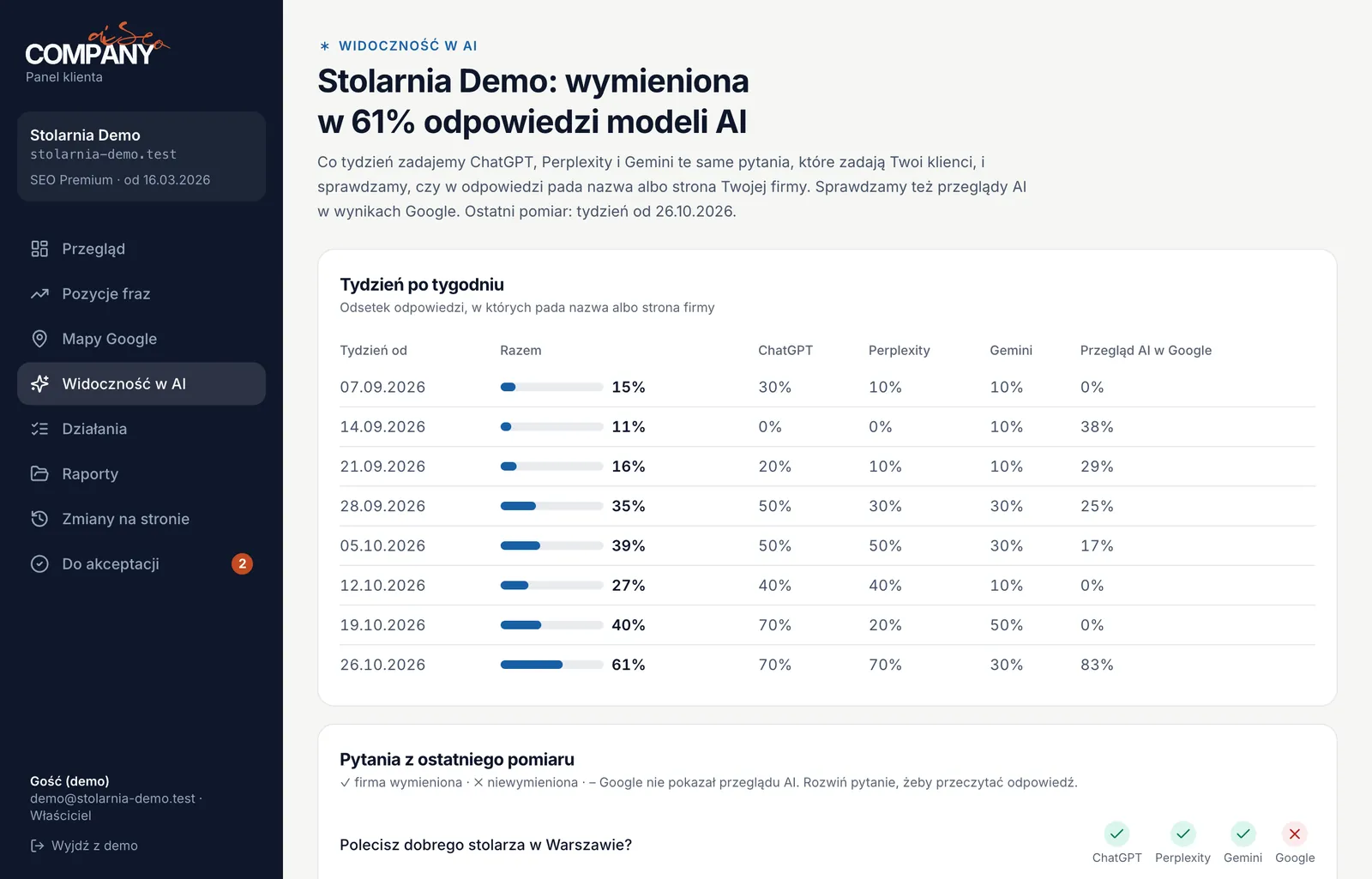
Measurement starts with a list of questions, not with a tool. Write down 20–50 questions that customers ask before buying: requests to recommend, questions about price and comparisons, with your city and services. Ask each question under the same conditions and record three things: whether your company name or page appears, whom the model recommends instead of you, and which pages it cites.
The share of answers that mention your brand is the result, and the list of cited pages is the work plan. By hand you can do this for a handful of questions, but dozens of questions across four sources every week need automation. That is how AI visibility measurement in the client portal works.
What cannot be bought or promised
You cannot buy a guarantee that ChatGPT will name your company when a customer asks for a recommendation. The model picks its sources itself, and its behavior changes with each version of the model and of search. An honest provider therefore promises work and measurement: specific changes to your business profile, your website and directories, and a result on the same questions week after week.
Remember, too, the difference between a measurement and what the customer sees. The answers in our test come from the API, and a customer in the ChatGPT app may get a different list, because the app takes their location and earlier conversations into account. That is why we treat the measurement result as a trend, not as a ranking.