Free SEO audit: a website SEO audit with a 1-100 score and a list of errors to fix
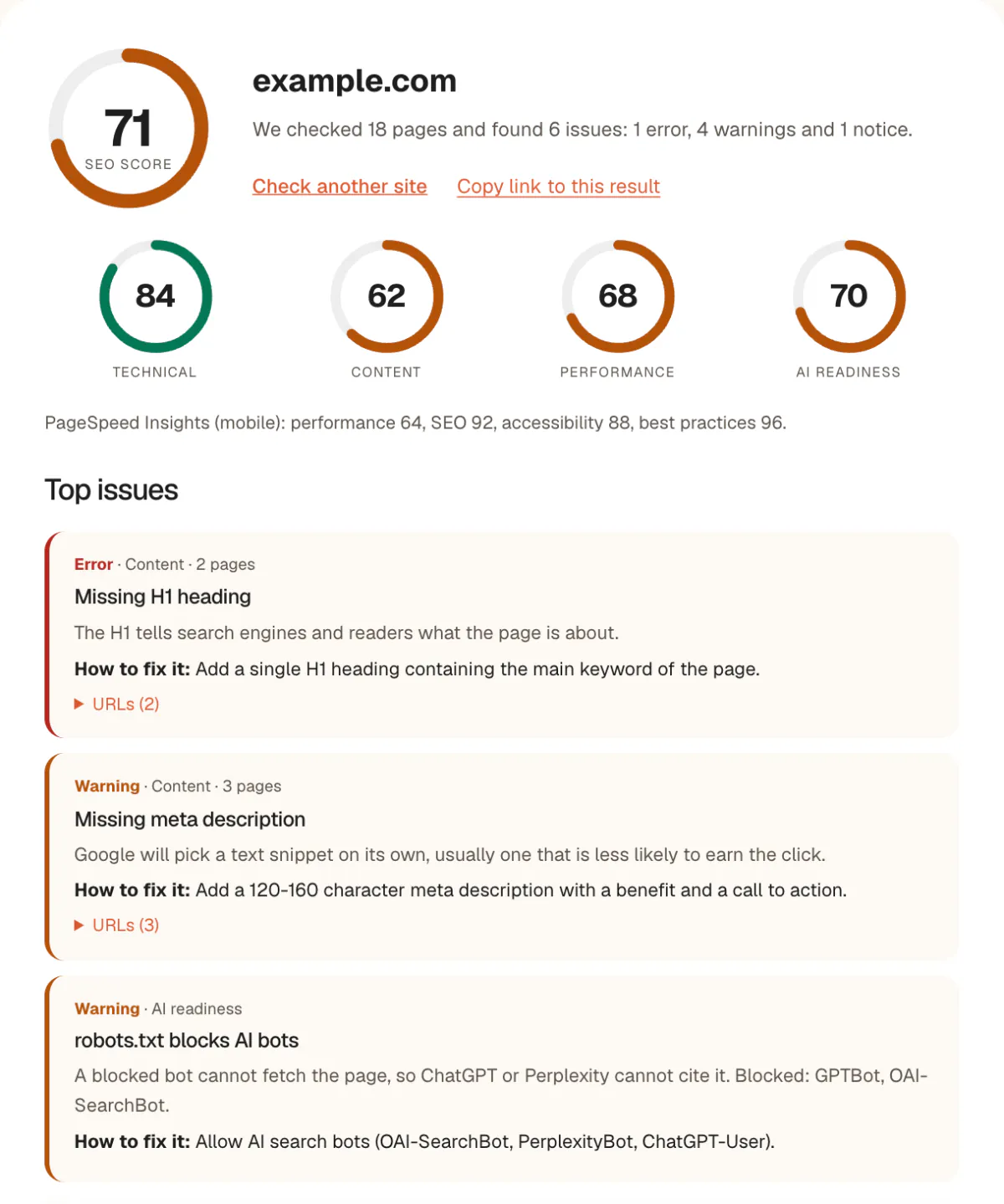
We check up to 25 pages against 49 rules and show your score, four category scores and the top three issues right away, with no sign-up.
Short answer
The free SEO audit checks up to 25 pages of your website, spread across its sections and language versions, against 49 rules: response codes, redirects, titles, descriptions, headings, content, images, structured data, robots.txt, the sitemap, mobile speed and AI bot access. The result is a score from 1 to 100 across four categories and a list of problems with fix instructions.
What you get in the free audit
Right away, with no sign-up
- A score from 1 to 100.
- A score for each of the four categories with the number of errors, warnings and notices.
- Four mobile PageSpeed Insights scores: performance, SEO, accessibility and best practices.
- The three most important issues with a description, fix instructions and sample page URLs.
- A link to the result that opens the audit with your address filled in (e.g. for your developer).
- The change in the score and categories since the previous audit of this domain, e.g. “+6 since the audit on 3 Nov”, if someone has checked it before.
After you enter your email
- Every issue we found with the affected page URLs (up to 25 per issue).
- A category filter: technical, content, performance, AI readiness.
- A report in your inbox that you can hand to a developer.
- If you want it: a monthly audit of this domain by email, with the change in the score and the new and fixed issues (separate consent and a confirmation link in an email, one click to turn it off).
What to do with it: start with the errors, then fix the warnings. Deal with the notices alongside other changes. Once you have made the fixes, run the audit again and compare the score.
What the free SEO audit checks: 49 rules in 4 categories
Every rule has a threshold set in the code, e.g. a title longer than 60 characters, a server response slower than 1.5 seconds or a home page heavier than 3 MB. For each issue you get a description of its effect, fix instructions and the URLs of the pages it affects.
Technical (21 rules, 35% of the score)
HTTPS and redirects, www and non-www versions, 4xx and 5xx errors, redirect chains, canonical URLs, noindex (including on the home page and across whole sections, e.g. a /en/ version), the lang attribute, the meta viewport tag, resources loaded over http:// on an https:// page, broken internal links and dead external links (404 or 410), soft 404 (whether a non-existent address returns 404), hreflang on the home page and on subpages of multilingual sites (including return links), robots.txt, the sitemap and URLs in the sitemap that should not be there (with noindex, a redirect, an error or a canonical pointing to another page).
Content (12 rules, 30% of the score)
Titles and meta descriptions (missing, length, duplicates), H1 headings (missing or more than one), the amount of text in the HTML (below 250 words is a warning), image alt text and Open Graph tags, which control how the page looks when shared on social media.
Performance (10 rules, 20% of the score)
The mobile Lighthouse score from Google PageSpeed Insights (the median of three independent runs, because a single run can vary by 10 points), LCP and CLS (from real-user data, if the site has it), home page weight with a list of the largest files, images to optimise (format, size, compression), images without width and height, server response time and HTML size.
AI readiness (6 rules, 15% of the score)
Whether the text is in the HTML without running JavaScript (AI bots do not run it), whether robots.txt lets in GPTBot, OAI-SearchBot, ChatGPT-User, PerplexityBot, ClaudeBot and Google-Extended, your company structured data (Organization or LocalBusiness) and valid JSON-LD, and an llms.txt file with links to your pages (you can create one in the llms.txt generator).
How we calculate the 1-100 score
Each of the 49 rules has a weight in points. A failed rule subtracts three times that weight from its category, and penalties add up. For page-level rules a single affected page already costs 40% of the penalty, and the rest grows with the share of pages. Site-wide rules, such as soft 404 or home page weight, subtract the full penalty. The final score is a weighted average of the four categories.
Example: noindex on the home page (a weight of 15 points) subtracts 45 points from the technical category, which is about 16 points of the final score. A missing meta description on 1 of 20 pages costs the content category just under 4 points.
| Category | Rules | Weight in the score | Heaviest rules |
|---|---|---|---|
| Technical | 21 | 35% | robots.txt blocks the whole site, noindex on the home page, 4xx and 5xx errors, no HTTPS |
| Content | 12 | 30% | missing page title, missing H1 heading |
| Performance | 10 | 20%, of which 70% is the mobile PageSpeed score (median of 3 runs) | PageSpeed below 50, home page heavier than 5 MB |
| AI readiness | 6 | 15% | content visible only after JavaScript runs, robots.txt blocks AI bots |
If PageSpeed Insights does not respond, performance is left out of the score and the weights of the other categories are scaled proportionally. The result then shows “Performance: not measured”.
How to read the score
A score of 80 or more means the basics are fine and it is worth focusing on content and links. From 50 to 79 there are problems that genuinely limit visibility: start with errors, then warnings. Below 50 the site has technical gaps that may stop Google from indexing it or make it show worse than your competitors.
The score is most useful next to your competitors. The audit works for any public website, so also check 2-3 businesses that rank above you: what matters is the difference in errors, not the number alone. You can compare the link strength of those domains in the domain authority checker.
The score is not a Google ranking. It shows how many obstacles stand in your site’s way. Rankings also depend on content, links and competitors, which we check in a full SEO audit.
How to improve your SEO score: where to start
The order of the steps follows the rule weights: first the things that cost the most points.
- Start with what blocks indexing. A robots.txt with Disallow: / for all bots, noindex on the home page, no HTTPS and pages with 4xx or 5xx errors carry the most weight in the score. Fix them before anything else.
- Text in the HTML, not only in JavaScript. If the audit shows “Content not visible without JavaScript”, turn on server-side rendering or prerendering. AI bots usually do not run JavaScript, so without it they have nothing to quote.
- Titles, descriptions and headings. Every important page needs its own title of up to about 60 characters, a meta description of 120-160 characters and a single H1 heading.
- Home page weight and images. Start with the largest files listed in the result: save images as WebP or AVIF at the size they are displayed, and give them width and height. Replace a background video with a poster image or a lighter version.
- AI bot access and company data. Let AI search bots (OAI-SearchBot, PerplexityBot, ChatGPT-User) in through robots.txt, add Organization or LocalBusiness structured data to the home page and an llms.txt file with links to your pages.
- Check again. Run the audit after the fixes. A single PageSpeed measurement can vary a lot: on 11 November 2026 eleven runs on our own website gave between 59 and 81 points. In the same test the median of two runs stayed between 69 and 76, so we measure three times at once and take the median. At the next audit of the same domain, the result shows the change since the previous one. Even so, judge mainly the change in the list of errors, not the number alone.
What the audit found on real websites
On 11 November 2026 we ran the audit on 6 Polish business websites and checked every finding by hand. A few examples (without company names, except our own):
- A service business with an English version: noindex on all 12 checked /en/ URLs, so the whole language version was out of Google. The home page was fine, so a single-URL audit would not show it.
- A furniture maker on WordPress: 2 URLs in the sitemap returning 404 (added by a theme plugin) and a home page weighing 15.9 MB, of which 13.9 MB was a background video.
- A 3D printing business: 2 links to Wikipedia articles that no longer exist (404). They are hard to spot by hand and they undermine trust in the content.
- A plumbing business: 24 pages where the server took longer than 1.5 seconds to respond.
- Our own website ai-seo-company.pl: a score of 94; mobile PageSpeed 76 (the median of runs scoring 79 and 72) and 72 for the whole performance category.
In the same test, a popular free SEO checker that analyses a single URL found none of the first three problems. That is exactly why we check up to 25 pages, a few from every section and language version.
A free SEO audit with no account: compared with Ahrefs Webmaster Tools and Search Console
Two popular free tools for checking a website require an account and proof that the website is yours. Our audit gives you the result on this page, with no account, including for a competitor’s website.
| Feature | Our free audit | Ahrefs Webmaster Tools | Google Search Console |
|---|---|---|---|
| Account | not needed | a free Ahrefs account | a Google account |
| Proof that the website is yours | no | yes, before the audit | yes |
| A competitor’s website | yes, any public website | no, other domains only on paid plans | no |
| When you get the result | on this page, usually after 20-90 seconds | in the app, after you set up a project and it is crawled | data builds up over a few days after you add the site |
| Scope | up to 25 pages, 49 rules | 5,000 crawl credits a month per project (1 credit = 1 HTML page with code 200) | the pages Google knows |
| AI readiness: AI bots in robots.txt, llms.txt, content without JavaScript | yes, 6 rules | not mentioned on the tool’s page | no, the reports cover Google’s crawlers |
| Real Google data: clicks, impressions, indexing | no | no, its own traffic and keyword estimates | yes |
Sources: Ahrefs, the Ahrefs Webmaster Tools and Website Checker pages (limits and FAQ), read on 11 Nov 2026; Google, Search Console Help: verify your site ownership and Search Console overview, read on 12 Nov 2026.
These tools complement each other. Search Console is the only source of real Google data about your website and is always worth having. Ahrefs Webmaster Tools will crawl more pages once you verify ownership. Our audit runs in a minute, with no account, also for a competitor’s website, and includes AI readiness rules.
What the free audit does not check
- We check a sample of up to 25 pages: the home page, the links on it and URLs from the sitemap (up to 10 child sitemaps). We pick a few URLs from every language version and section, e.g. /blog/ and /services/, but on a large website most pages stay outside the audit.
- We measure speed in PageSpeed Insights on mobile, for the home page only: three lab runs at once and the median of those that finish within 30 seconds. In our test on 12 Nov 2026 at least two runs finished in 36 of 37 attempts. If only one finishes, the result comes from a single run and the result says so. Real-user data (LCP, CLS) appears only if Google has it.
- We read the HTML as the server sends it, without running JavaScript, the way most AI bots do. Content added by scripts may be invisible in the audit, and that is a finding in itself.
- We detect duplicate titles and descriptions only among the pages we checked, and we apply content rules only to pages without noindex.
- We check external links only for 404 and 410 codes, up to 30 URLs and no more than 3 per domain. We skip social networks, which block crawlers.
- We do not check links pointing to your site, keywords, Google rankings or Search Console data. That is the scope of a paid SEO audit.
Free audit vs a full SEO audit
| Free audit | SEO audit (from €350 net) | |
|---|---|---|
| Scope | up to 25 pages | the whole website |
| What it checks | 49 automated rules: technical, content, performance, AI readiness | the same plus keywords, competitors, the link profile and Search Console data |
| Time | usually 20 to 90 seconds | 3 to 5 business days |
| Result | a 1-100 score and a list of problems with fix instructions | every error with a priority and instructions for a developer, a plan of changes and a quote |
| Account | not needed; email only for the full list | – |
Guides for this tool
- Technical SEO Audit Checklist for Digital Marketers: thresholds for each check, so you know what to fix first
- Why responsiveness & Core Web Vitals are key to top Google rankings: how LCP, INP and CLS affect rankings
- SEO Canonical Tag: what it is and how to implement it in 2026: how to fix the duplicates the audit finds
More free tools
- AI visibility checkwhether ChatGPT, Gemini, Perplexity, Claude and Google AI Overviews name your business
- SEO loss calculatorthe monthly profit you lose without a Google top 3 position and AI recommendations
- Website redesign mockupa new AI homepage design in 1-3 minutes, built from your content
- llms.txt generatoran llms.txt file from your sitemap and an access test for 8 AI bots
- Domain authority checkera 0-100 score from the Common Crawl link graph, compared with up to 3 competitors
- All free tools and templatesthe full list, with SEO templates to download
Questions about the free SEO audit
Yes. You see the score, the categories and the three most important problems right away, with no sign-up. We show the full list of problems with page URLs after you give an email address, which we also send the report to. Signing up for the newsletter is separate and voluntary.
Each of the 49 rules subtracts points from its category when it fails. The score is 35% technical, 30% content, 20% performance (including the mobile PageSpeed Insights score) and 15% AI readiness; details are in “How we calculate the 1-100 score”.
The free audit automatically checks up to 25 pages against 49 rules. A paid SEO audit (from €350 net, 3 to 5 business days) covers the whole website, keywords, competitors, the link profile and Search Console data, and its result is a plan of changes with priorities and a quote.
No. We fetch up to 25 pages, a few at a time, with a self-identifying robot called AISEOCompanyAudit. That is less than a single visit from a search engine. We do not submit forms and we do not log in.
Yes. The audit works for any public website and does not ask you to prove that you own it. Comparing yourself with 2-3 businesses in your industry shows whether a problem affects only you. The limit is 5 audits per day from one IP address.
Every tool has its own set of rules and weights. We check up to 25 pages at once, not just the home page, and add AI readiness rules. The PageSpeed score is the median of three lab runs, but it can still differ from a result taken on another day or in another tool. Compare the list of problems, not the number alone.
After every major change: a new theme, a migration, a plugin or a batch of new pages, and otherwise once a month. You can turn on a monthly audit after you unlock the full result, and we will send it for you.
Yes. If someone has already checked this domain, for example you before the fixes or your developer, the result shows the change in the score and in each category, e.g. “+6 since the audit on 3 Nov”. We compare numbers only: the score, the categories and the date of the previous audit, with no data about the person who ran it, and only audits scored with the same rules (from 12 November 2026). After you unlock the result, you can also tick the monthly audit: once a month we will email you the score with the change and a list of new and fixed issues. It starts only after you confirm your address with the link in an email (without the click we send nothing), and you can turn it off with one click in any email.
We store the website address and the result so we can show the full list after you enter your email and send the report. We delete them after 60 days. The numbers from the result (the score and the categories) are also used to show the change at the next audit of this domain. If you turn on the monthly audit, we keep your email address and the domain until you turn it off. Newsletter signup is separate and voluntary. Details are in the privacy policy.
Sources
- Google: PageSpeed Insights API v5 (Lighthouse and Chrome UX Report data) (accessed November 9, 2026)
- Google Search Central: introduction to robots.txt (accessed November 9, 2026)
- OpenAI: Overview of OpenAI Crawlers (GPTBot, OAI-SearchBot, ChatGPT-User) (accessed November 9, 2026)