SEO loss calculator: how much profit you lose without SEO and AI visibility
Enter five numbers about your business or online shop and the calculator instantly shows the range of monthly profit you lose without a Google top 3 position and AI recommendations. Pick a package to also see whether and when SEO pays off.
Short answer
The calculator estimates how much profit goes to competitors each month when your business is not in Google’s top 3 or in ChatGPT and Gemini answers. It uses your data: the number of searches, current traffic, conversion rate, customer value and margin, plus open assumptions: Google CTR studies, the impact of AI Overviews and the share of visits from AI answers. The result is given as a range, and once you add the cost of SEO it shows the balance and the payback month. For online shops it has a separate mode that uses average order value, gross margin and, optionally, the share of customers who buy again.
What you get for free
Right away, no email needed
- The range of lost profit: per month and per year
- The split between Google and AI answers, with the number of visits
- The number of customers you lose each month
- SEO cost and payback month for our packages or your own amount
- In shop mode: lost gross profit, sales and number of orders
- A link that recreates the result with the same numbers
After you enter your email
- A summary by email: the result, assumptions, sources and a short action plan
Your browser calculates the result. You only enter an email address if you want the summary.
How we calculate the loss
- Potential in Google: searches minus the share that goes to AI assistants, times the average CTR of positions 1-3: 13.9% in the cautious variant and 22.9% in the optimistic one.
- Google AI Overviews: for 18% of searches, clicks fall from 15% to 8% of visits, so we lower CTR proportionally.
- Loss in Google is the potential minus your current Google traffic (never less than zero).
- Loss in AI: the share of questions asked to AI assistants times the share of people who then visit the recommended business’s website: 1% in the cautious variant (Pew Research Center: a link inside the AI summary is clicked in 1% of visits) and 3% in the optimistic one (Similarweb: fewer than about 3% of Google AI Mode searches end with a click to another website). That is several times less than the CTR of positions 1-3 in Google. We count it only if the models do not recommend your business today.
- “Not sure” answer: we count 50% of the AI loss in the cautious variant and all of it in the optimistic one, because assistants recommend few businesses: according to SOCi (2026), ChatGPT recommends 1.2% of business locations, while Google shows 35.9% in the local pack.
- Profit: lost visits times conversion rate, customer value and margin. The yearly figure is the monthly one times 12.
For comparison: in June 2025 AI platforms sent 1.13 billion visits to the world’s 1,000 largest websites, while Google Search sent 191 billion (Similarweb). According to Conductor, visits from AI assistants make up 1.08% of website traffic. That is why the AI part is smaller than the Google loss today.
Want to know what it costs to win that traffic back? Package prices are in the SEO pricing, and you can check your AI visibility in the AI visibility audit.
Will SEO pay off: cost and payback month
Under the result you pick a package from our SEO pricing or enter your own amount, for example another agency’s quote. The calculator works in Polish zloty, so we use the PLN prices (with the euro prices from our English pricing in brackets), net per month: SEO Standard from PLN 1,900 (€450), SEO Premium PLN 2,500 (€590), Booster Pack PLN 2,500 (€590) (3-month minimum, new website included). For a “from” price we use the starting amount.
- Monthly balance: the recovered profit at full effect minus the package cost. We show it for both loss variants.
- Build-up: rankings do not grow from day one, so we assume the recovered profit grows evenly over the number of months you choose (default 12, from 1 to 24) and then stays flat. The default of 12 months is our assumption, not a study result. According to Ahrefs (2025), 1.74% of newly published pages reach Google’s top 10 within a year and 72.9% of top 10 pages are more than 3 years old, so with a new domain set more.
- Payback month: the first month in which total recovered profit catches up with total cost paid. We look for it within 36 months.
- Break-even share: how much of the calculated loss you need to recover for the profit to cover the cost. Above 100% the package at this price does not pay off even with full success.
This is arithmetic on your numbers, not a promise of results. No honest agency can guarantee a top 3 position, which is why next to the payback month we show the break-even share and the first-year balance. What we do each month is described on our SEO services and AI search optimization pages.
Example: a service business
A service business has keywords that customers type into Google 2,000 times a month, and today it gets 150 visits from Google. One in 50 visitors becomes a customer (a 2% conversion rate), a customer pays PLN 1,500 on average and the margin is 40%. The owner does not know whether ChatGPT recommends the business and leaves the default 25% of questions asked in AI. The calculator shows a loss of PLN 522 to PLN 2,156 in profit per month: PLN 492–PLN 1,976 in Google and PLN 30–PLN 180 in AI, or 0.9–3.6 customers a month. When AI models already recommend the business, the loss falls to PLN 492–PLN 1,976.
With the SEO Standard package (from PLN 1,900 net a month) and full effect after 12 months, the monthly balance is −PLN 1,378 to +PLN 256, and the cost does not pay back within 36 months. At this demand and customer value the package does not pay off, and the calculator says so instead of promising a return.
Example: a renovation company with high-value jobs
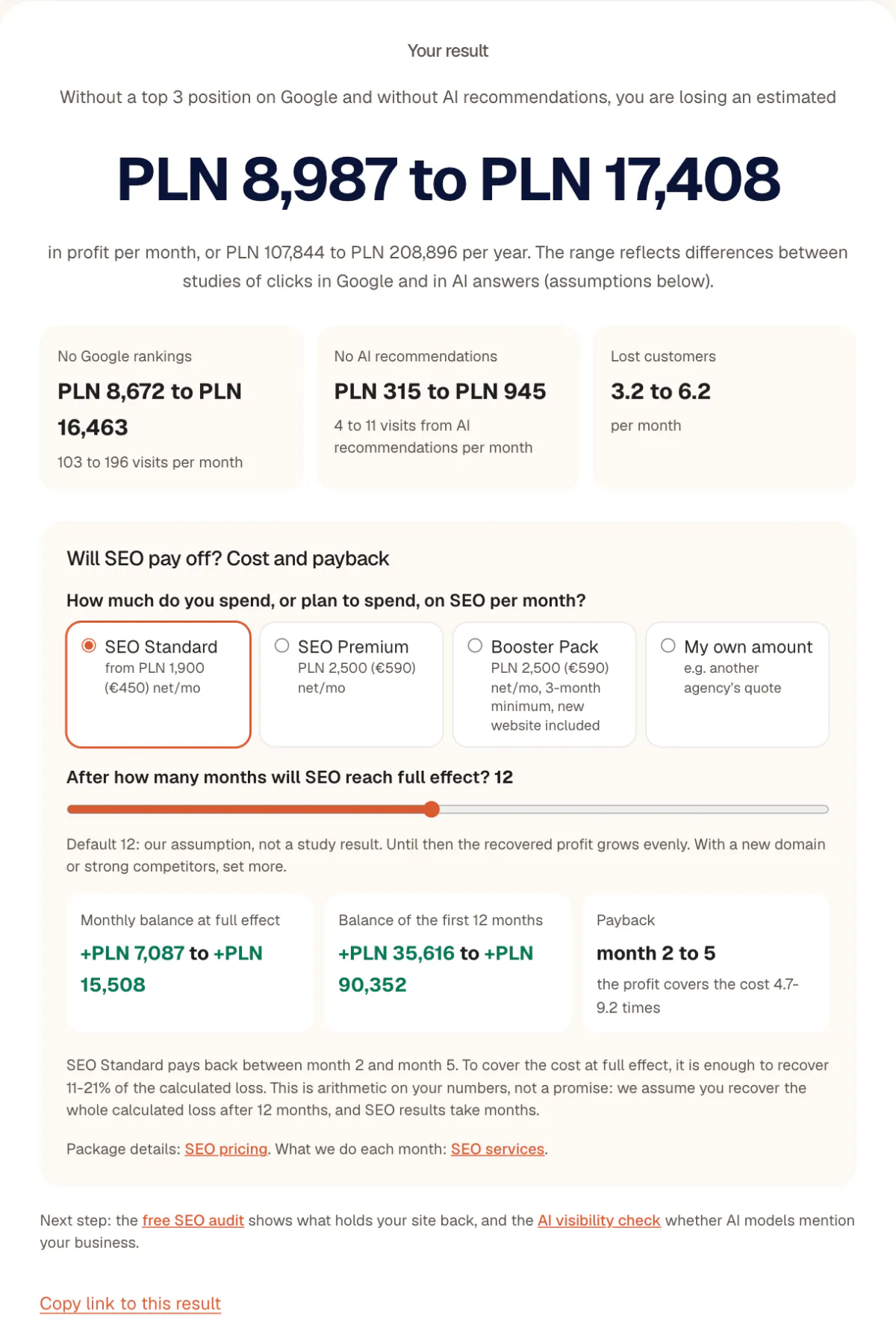
A renovation company has keywords typed 1,500 times a month and gets 40 visits from Google today. 3% of visitors become customers, a job is worth PLN 8,000 on average, the margin is 35% and AI models do not recommend the business. The loss: PLN 8,987–PLN 17,408 in profit per month, of which PLN 8,672–PLN 16,463 in Google and PLN 315–PLN 945 in AI, or 3.2–6.2 jobs a month.
With the same SEO Standard package, the monthly balance at full effect is +PLN 7,087 to +PLN 15,508, the balance of the first 12 months is +PLN 35,616 to +PLN 90,352, and the cost pays back between month 2 and month 5. To cover the cost it is enough to recover 11-21% of the calculated loss. What makes the difference between the examples is the customer value, not the number of searches.
The calculator for an online shop
Choose “Online shop” above the form. The model of visits from Google and from AI answers stays the same as for services; what changes is the data you enter and what the result shows.
- Average order value instead of customer value: sales revenue divided by the number of orders, from your store admin or GA4.
- Gross margin: the selling price minus the cost of goods, as a percentage of the price. The result is lost gross profit, shown next to lost sales (revenue before margin). Want to include shipping, payment fees and product returns? Enter the margin after those costs.
- Shop conversion rate: orders divided by sessions. For comparison: according to Littledata, the median across 450 Shopify stores (GA4 data, August to November 2026) is 1.3%, and the top 10% of stores are above 3.6%.
- Returning customers (optional field): we assume a returning customer places one extra order within a year, so a lost new customer equals 1 + the repeat share in orders. This is a cautious assumption, because some customers come back several times. An empty field means the first order only. We do not give a “typical” share, because it depends heavily on the industry: people buy dog food every month and a sofa once in years.
- Cost and payback work the same way as for services: we compare the cost of SEO with the lost gross profit.
Example: a shop has category and product keywords typed 30,000 times a month and gets 1,800 visits from Google today. The conversion rate is 1.3%, the average order PLN 220, the gross margin 35%, and 25% of customers buy again. The owner does not know whether AI recommends the shop. The loss: PLN 1,379–PLN 3,935 in gross profit per month on PLN 3,941–PLN 11,242 in lost sales, or 17.9–51.1 orders a month. Without returning customers the loss would be PLN 1,103–PLN 3,148.
With the SEO Standard package (from PLN 1,900 net a month) and full effect after 12 months, the monthly balance is −PLN 521 to +PLN 2,035, and the cost pays back in month 11 in the optimistic variant only. So the answer depends on which click variant turns out closer to reality in your industry, and the calculator shows this openly.
What the calculator does not calculate
- How much of the loss you will actually recover. The cost part assumes you recover the whole calculated loss after the number of months you choose. That is why next to the payback month we show the break-even share: how much of the loss is enough for the cost to pay back.
- The time it takes to reach the top 3. The loss assumes positions that usually take months to build. The yearly figure is the loss at your current position, not a growth forecast. In the cost part you set the time to full effect yourself.
- Seasonality and the strength of competitors. We calculate an average month. With seasonal demand or very strong competitors the real figure will be different.
- Traffic from other sources. We do not count visits from ads, your Google Maps listing or offline referrals.
- Sales outside your shop. In shop mode we do not count Allegro, Amazon or other marketplaces, Google Shopping ads or free listings in the Shopping tab. We count positions in regular Google results and recommendations in AI.
- Costs beyond the monthly amount. The calculator takes the net package price or your own amount. It does not add VAT or your own time.
- The exact number of visits from AI chats. There is no public data on how many visits one ChatGPT recommendation brings. That is why we calculate the AI part with a rate from studies of clicks in AI answers (1-3%), not with Google ranking CTR. It is the least certain part of the result and today usually the smallest.
How to reduce the loss: where to start
- Find what holds your site back. The free SEO audit checks up to 25 pages against 49 rules and shows the errors that get in the way of Google and AI bots.
- Replace “not sure” with an answer. The AI visibility check asks AI models your customers’ questions and shows whether they mention your business. Then you can answer “yes” or “no” in the calculator instead of “not sure”.
- Start with the keywords with the most demand. Compare your pages with the top 3 for those keywords: content, answers to customer questions, reviews, speed. Our competitor analysis guide shows how, step by step.
- Let AI bots in. The llms.txt generator checks whether 8 AI bots can access your site and prepares an llms.txt file.
- Calculate again. Enter new numbers from Google Search Console after a few months of work and compare the loss with the package cost.
Guides for this tool
- How much does SEO cost in Poland? Pricing and packages 2026: compare the calculated loss with a package price
- SEO Competitor Analysis: A Step-by-Step Guide: find out who takes your clicks
More free tools
- Free SEO audita 1-100 score and a list of errors for up to 25 pages
- AI visibility checkwhether ChatGPT, Gemini, Perplexity, Claude and Google AI Overviews name your business
- Website redesign mockupa new AI homepage design in 1-3 minutes, built from your content
- llms.txt generatoran llms.txt file from your sitemap and an access test for 8 AI bots
- Domain authority checkera 0-100 score from the Common Crawl link graph, compared with up to 3 competitors
- All free tools and templatesthe full list, with SEO templates to download
Questions about the loss calculator
CTR studies differ a lot: according to First Page Sage the first position in Google gets 39.8% of clicks, while according to a 2025 GrowthSRC study it gets 19%. We calculate both variants so we do not inflate the result or promise a single number.
We take the impact of Google AI Overviews from a Pew Research Center study (March 2025): with an AI summary users clicked a result in 8% of visits, without one in 15%, and a summary appeared for 18% of searches. Few people go from an AI answer to a business website: a link inside the AI summary was clicked in 1% of visits (Pew), and fewer than about 3% of Google AI Mode searches end with a click to another website (Similarweb, 2025). That is why we calculate the AI loss with a 1-3% rate, not with Google ranking CTR. You set the share of questions asked to AI assistants yourself; the default 25% is a Gartner forecast.
No. It is an estimate of potential at top 3 positions and presence in AI answers, calculated from your data. How much of it you can recover depends on competition, budget and the quality of your website.
From Google Ads Keyword Planner (free once you have an account) or from SEO tools. Add up the monthly searches of a few main keywords, for example “service + city”. You can check your Google traffic in Google Search Console.
It does not price the scope of work. First it shows how much profit you lose today without a top 3 position and AI recommendations, and in the “Will SEO pay off?” part it compares that amount with a package price or your own amount and shows the payback month. Our SEO packages start from PLN 1,900 (€450) net a month, with details in our SEO pricing.
It depends on how much profit you lose and how much you pay. The calculator assumes the recovered profit grows evenly over 12 months (you can change this) and looks for the month in which total profit catches up with total cost, within 36 months. With low demand a package may never pay off; with high-value customers it pays back in a few months. We show both cases in the examples on this page.
Your conversion rate is the month’s enquiries or orders divided by the visits to your site in the same month. Without data, enter a value lower than you expect: the result will be more cautious. A 100% margin shows revenue instead of profit.
Your browser calculates the result and sends nothing until you ask for the summary by email. Then we store the numbers you entered (including the SEO cost, if you choose one), the result and your email address for 60 days so we can send the report.
Because people rarely click from AI answers: according to Pew, a link inside the AI summary is clicked in 1% of visits, and according to Conductor visits from AI assistants make up 1.08% of website traffic. A recommendation in ChatGPT or Gemini brings fewer visits today than a top 3 position in Google. For the same reason a higher share of questions asked in AI lowers the result: it moves demand from Google to a channel where few people click.
Yes. Choose “Online shop” above the form. You enter the number of searches for your category and product keywords, traffic from Google, your shop’s conversion rate, average order value, gross margin and, optionally, the share of customers who buy again. The model of visits from Google and AI is the same as for services, and the result shows lost gross profit, sales and the number of orders. SEO cost and the payback month work the same way.
Your gross margin: the selling price minus the cost of goods, as a percentage of the price. The calculator does not deduct shipping, payment fees, product returns or advertising costs, so if you want to include them, enter the margin after those costs. A 100% margin shows lost sales instead of margin.
If you enter the share of customers who buy again, we assume one extra order within a year from each returning customer: at 25%, one lost new customer equals 1.25 orders. Many loyal customers buy more often, so this is a cautious assumption. Without this field we count the first order only. You will find the share in the customer report of your store admin: customers with at least two orders in a year divided by all customers.
According to Littledata, the median across 450 Shopify stores (GA4 data, August to November 2026) is 1.3%, the top 20% of stores are above 2.8% and the top 10% above 3.6%. In the calculator, enter your own conversion rate from GA4 or your store admin: orders divided by sessions.
Sources
- First Page Sage: Google CTR by ranking position (2025): position 1 39.8%, position 2 18.7%, position 3 10.2% (accessed November 9, 2026)
- GrowthSRC Media study (over 200,000 keywords): CTR for position 1 fell from 28% to 19%, for position 2 from 20.8% to 12.6% (2024 to 2025) (accessed November 9, 2026)
- Pew Research Center: with an AI summary, users click a result in 8% of visits, without one in 15%, and a link inside the summary in 1% of visits; summaries appear in 18% of searches (March 2025) (accessed November 11, 2026)
- Gartner (February 2024): forecast of a 25% drop in search engine volume by 2026 due to AI chatbots (accessed November 9, 2026)
- iPullRank, Similarweb data (over 100,000 users, May to August 2025): fewer than about 3% of Google AI Mode searches end with a click to an external website (accessed November 11, 2026)
- SOCi, 2026 Local Visibility Index (over 350,000 locations, 2,751 brands): ChatGPT recommends 1.2% of business locations, Google shows 35.9% in the local pack (accessed November 11, 2026)
- TechCrunch, Similarweb data (June 2025): AI platforms sent 1.13 billion visits to the 1,000 largest websites, Google Search sent 191 billion (accessed November 11, 2026)
- Conductor, 2026 AEO/GEO Benchmarks (1,215 company domains, 3.3 billion sessions, US, May to September 2025): visits from AI assistants are 1.08% of website traffic across 10 industries, 87.4% of them from ChatGPT (accessed November 11, 2026)
- Ahrefs, Patrick Stox (May 2025): 1.74% of newly published pages reach Google’s top 10 within a year; 72.9% of top 10 pages are more than 3 years old (accessed November 12, 2026)
- Littledata, store conversion rate benchmark (450 Shopify stores with data in GA4, August 10 to November 7, 2026): median 1.3%, top 20% above 2.8%, top 10% above 3.6% (accessed November 12, 2026)